Victory @ The Science Fair
Breaking News!!!! I just won 2nd place at the Long Island Science and Engineering Fair (LISEF)!! It was the first time I ever entered a real science competition, and I worked on my project for over six months. That’s longer than some people train for a marathon!
So, remember my last blog on GLP-1? Basically, I was trying to figure out if tiny differences in our GLP-1 receptor gene could explain why some people respond really well to GLP-1 medications—and others don’t.
As a reminder, GLP-1 is a hormone that helps your pancreas release insulin and tells your brain when you’re full. But some people have genetic variants in their GLP1R gene—the one that makes the GLP-1 receptor. If that receptor doesn’t work right (because of a mutation), the medicine might not work as well. But if the receptor is super responsive? The medicine could be extra effective.
So what was the outcome of my science project and all the research I analyzed? I found that your genes might help predict how well GLP-1 treatments will work for you. This is known as a biomarker, and it could help make medicine more personal and precise in the future.
So if you are reading this and wondering if Science Fairs are your thing, the immediate answer is YES. It’s not for everyone but if you are curious, enjoy learning new things and testing out hypotheses, check out a few key things you should be aware of before going down that route.
Behind the Scenes: How I Made It Happen
Here’s what most people don’t see when you walk by a cool science fair project:
It’s a Big Commitment. I started researching in the fall and kept going all the way through winter and spring. I read, re-read, and read even more scientific papers (which were sometimes full of words I had to Google), made charts, studied gene variants, and learned how GLP-1 works in the body.
Choose a Sponsor. In order to compete at LISEF competition, I not only had to get my school to agree, but I had to get a teacher to sponsor my project - and I had the perfect person who not only supported my work but also represented our school on the day of the competition - Shout out to Dr. Messina!
Have Fun, Be Creative! You get to design and craft a tri-fold science fair poster that is your showstopper - it’s your one opportunity to showcase your research, data, and any related diagrams / content related to your project. I wasn’t sure what it was supposed to look like so I searched Google for some design ideas and then took it from there - I had a blast making mine, using my school colors as the backdrop, with key diagrams including a super cool one of how GLP-1 travels through the body. What I liked about the presentation was bringing my project to life in front of the other students and judges
Practice, Practice & Practice Some More. For the fair, I had to memorize a 6- to 7-minute speech explaining my project. That meant practicing it over and over (and over) until I could say it confidently.
After presenting, the judges asked me tough questions. Things like:
“What other genes might be involved in this pathway?”
“How would you test this hypothesis in real life?”
“Why do you think personalized medicine is important?”
I was nervous, but I stayed calm and answered with everything I had learned. I felt like a real scientist.
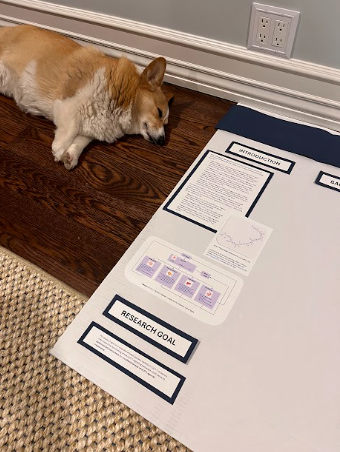
This is my dog sleeping next my board!
The Big Day
On the day of the science fair, I was so nervous! But when I got up to present, it clicked. I knew my project, I believed in my project, and I had fun sharing what I’d learned.
AND THEN… I found out I got SECOND PLACE in my whole category!There were older kids there, so this was a huge deal for me.
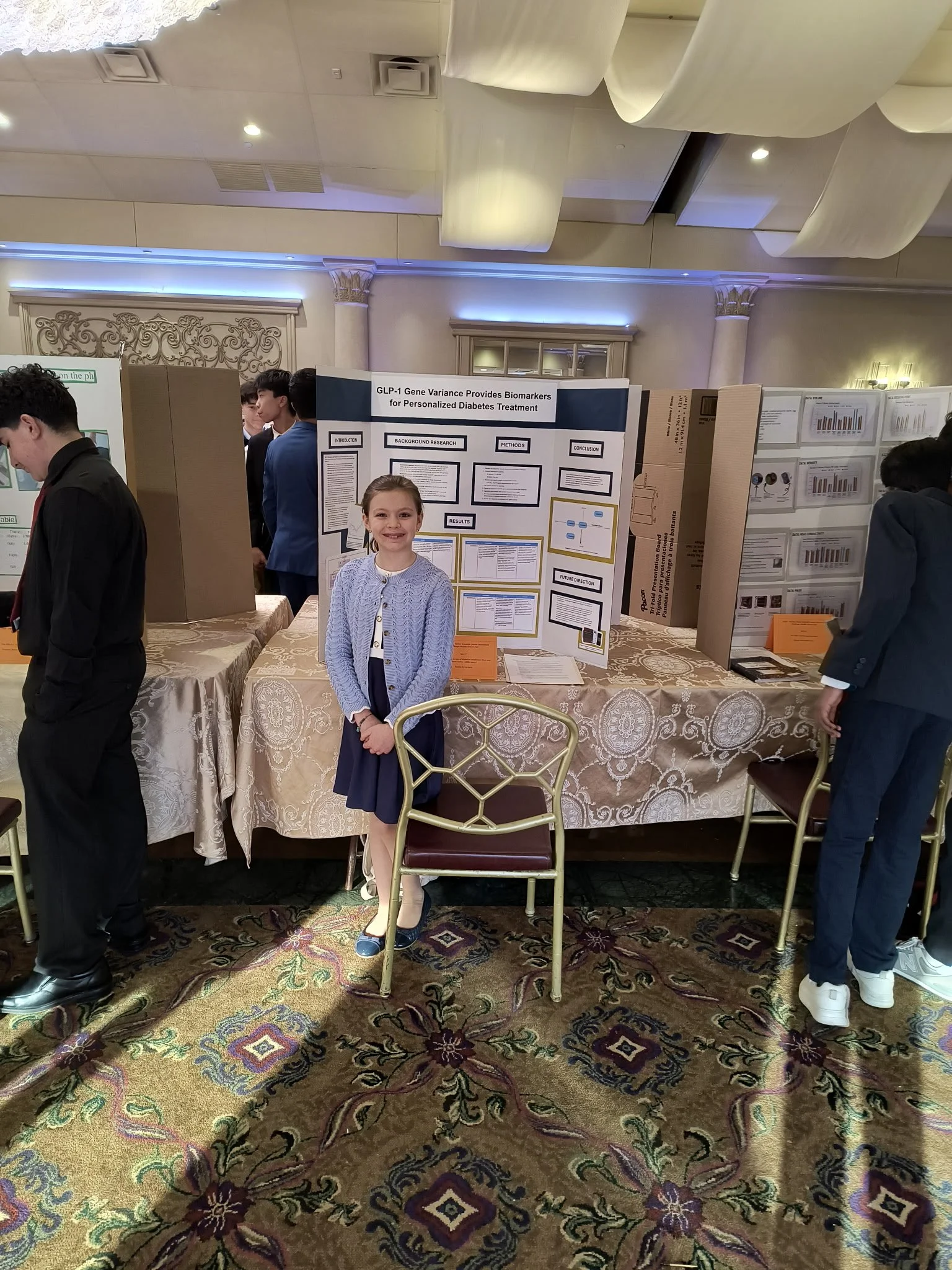
This is a photo of me during the Fair!! I was really excited and nervous!