From Humans to Hounds: My Wild Ride Through Research Approval
This fall, I had an experience that was both challenging and unexpectedly pawsome 🐾. I started out with a big dream: I wanted to study GLP-1 Receptor genes in humans to understand how certain genetic variants might relate to metabolism. It sounded simple enough — until I ran into something called the Institutional Review Board (IRB). If you’ve never heard of the IRB, it’s basically a team that makes sure all research involving people is safe, fair, and ethical ⚖️. They review everything — from consent forms to how researchers store data.
🔎 Fun Fact: Research ethics rules became much stricter after the 1970s to protect volunteers in scientific studies. Learn more about research ethics here: https://www.genome.gov/about-genomics/policy-issues/ethics
But here’s where things got tricky: the CSHL IRB board said I couldn’t conduct human-based genetic research, even with supervision. I was devastated 😭. I had already spent weeks designing the project and planning how I’d collect cheek swab samples from volunteers. I even practiced labeling tubes and preparing my materials! Then I got a call that would change my whole perspective…my superstar mentor, Mr. Jeffry Petracca had the brilliant idea to instead do the study with dogs 🐶. I was speechless and excited at the same time - what an idea!!!
Switching from humans to dogs opened a whole new world of science — and honestly, it turned out to be even more exciting. Unlike human DNA studies, animal genetic research usually has fewer regulatory hurdles than studies involving human subjects. Plus, dogs share many genetic similarities with humans, making them a great model for understanding health and biology.
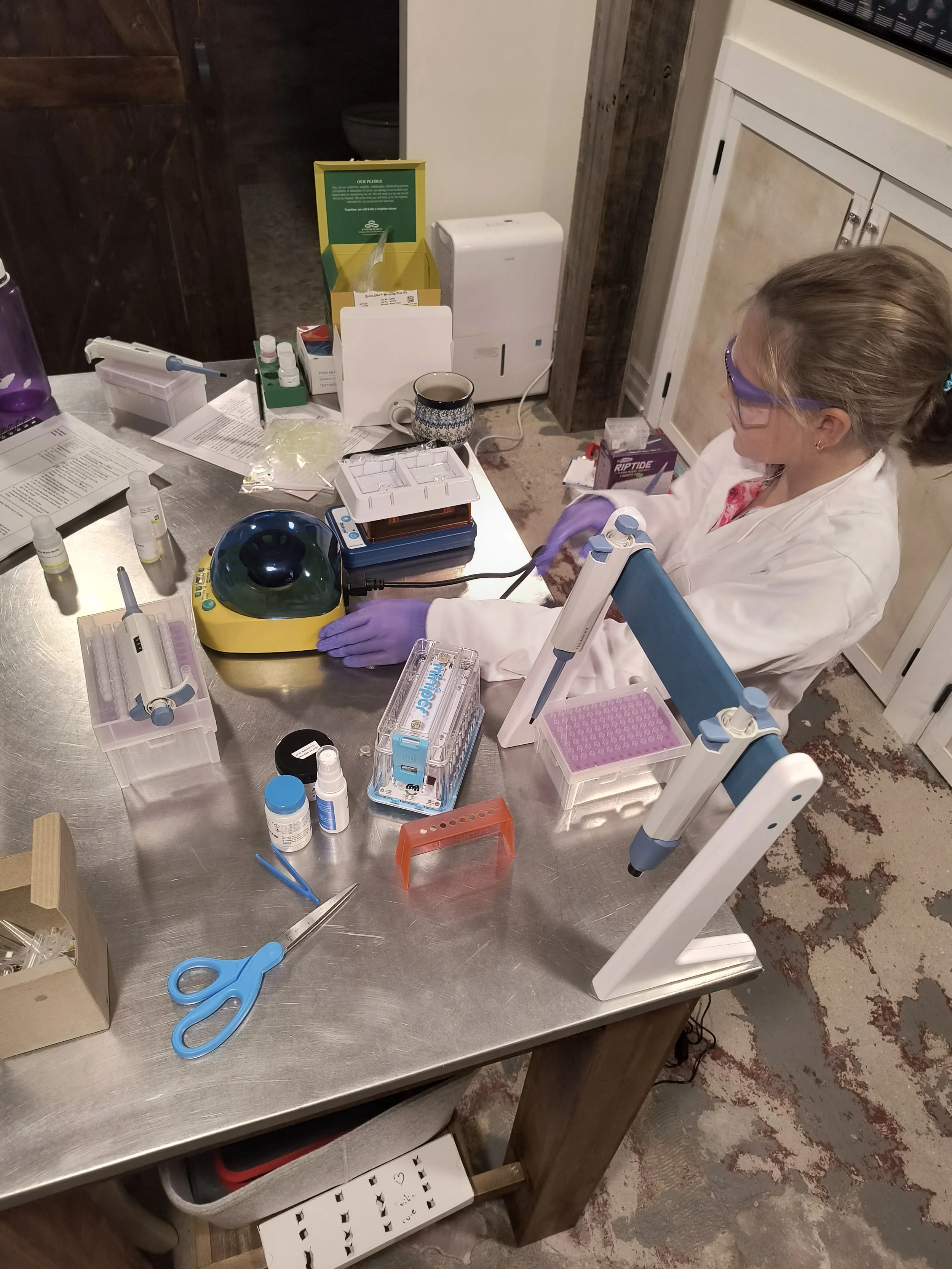
Lab testing!
This is me in the lab testing how dog samples would work.
🧬 Fun Fact: Dogs share ~84% of their genes with humans, which is one reason scientists often study canine genetics to learn about diseases that affect both species. Learn more here: https://www.genome.gov/news/news-release/Dog-Genome-Sequenced
I redesigned my project to focus on identifying the same four variants of the GLP-1 Receptor gene that I studied in humans the previous year—this time in different dog breeds 🐶. My mentor, Mr. Jeffry Petracca, taught me proper lab safety and guided me through the process of collecting DNA samples, extracting the genetic material, and analyzing it to look for genetic differences. Working step-by-step in the lab made me feel like a real scientist .
Along the way, I learned that science isn’t just about perfect experiments or smooth progress—it’s about adapting when things don’t go as planned. I explored DNA Extraction, learned about research ethics, and even picked up a little veterinary science .
🧪 Fun Fact: Scientists can extract DNA from many sources—including saliva, hair follicles, and cheek cells! Learn how DNA extraction works: https://www.yourgenome.org/facts/what-is-dna-extraction
Looking back, what first felt like a setback turned into an incredible opportunity to learn from some amazing (and very kid-friendly!) scientists at the Cold Spring Harbor Laboratory DNA Learning Center. I had the chance to work with and learn from Mr. Jeffry Petracca, Dr. Ashley Caruana, Ms. Allison Astudillo, and Ms. Joeli Marrero —all experts who helped make the experience both challenging and fun 🧑🔬.
In the end, I realized that sometimes the best discoveries happen when you take a detour—even if that detour is covered in fur and wagging its tail 🐕✨.